Showing posts with label double integral. Show all posts

Saturday, May 9, 2026

Change of variables for double integrals

 We have seen that under the change of variables T(u,v) = (x,y) where x = g(u,v) and y = h(u,v), a small region ΔA in the xy plane is related to the area formed by the product 𝜟u 𝜟v in the uv plane by the approximation: 𝜟A ≃J(u,v)𝜟u𝜟

Remember that the double integral is defined as:


In the following figure we divide the region S in small rectangles Sᵢⱼ and the region R in small rectangles Rᵢⱼ. A small rectangle Rᵢⱼ is the image of a small rectangle Sᵢⱼ under the transformation T.


Let's substitute f(xᵢⱼ, yᵢⱼ) and ΔA in the definition of the integral:

∫∫R f(x,y) dA = ∫∫S f(g(u,v),h(u,v)) |J(u,v)| du dv

Let's substitute J(u,v) in in the expression on the right side of the equality sign, we have:


Theorem


Example


Solution


Let's do the change of variables in the expression x2 + y2 . By substituting x = rcosθ and y = sinθ, the expression becomes equal to r.

The expression dydx becomes J(r,θ) drdθ.  In a previous example J(r,θ) was equal to r. The integral becomes when we substitute everything:


Practice


Saturday, March 14, 2026

Finding the moments of inertia of a solid in two dimensions.

 Goal: Find the moment of inertia of a solid in two dimensions

Let's go back to the lamina considered in earlier post where we calculated its mass. In order to do that we considered the region R occupied by the lamina. We divided the lamina into tiny subrectangles. Our goal now is to find the different moments of inertia of the solid.


.

Let's find the moment of inertia about the x-axis.

 The moment of inertia of a solid about an axis is equal to its mass by the square of its distance from this axis.

The moment of inertia of the lamina about the x-axis is equal to the sum of the moments of the tiny subrectangles of the lamina.

The moment of inertia of a subrectangle about the x-axis is equal to the product of its mass by the square of its distance from the x-axis. This moment is calculated as: 

Let's add all the moments of the subrectangles. This comes to take the Rieman sum of the product and to determine its limit.                                                                                                                                         


The moment of inertia of a subrectangle about the y-axis is equal to the product of its mass by the square of its distance from the t-axis.  Hence, the moment is given by:                                                                      


Adding all the moments together allows to find the moment of the lamina about the y-axis. This leads to use the Rieman sum of the product and take its limit.


Example


Solution


Practice


Saturday, March 7, 2026

Center of mass in two dimensions

 The center of mass of an object is called the center of gravity if the object is located in a gravitational field. If the object has a uniform density, the center of mass is the geometric center of the object, which is called the centroid. The following figure shows the point P as the center of mass of a lamina (flat plate).


Restating the center of mass in terms of integrals, we have:


If the object has uniform density, the density function ⍴(x,y) is constant and the formulas become:


Example


Solution


Practice


Saturday, February 28, 2026

Application of double integrals: finding moments about x and y axes

 Objective: Finding moments about x and y axis


Let's find the moments with respect to x and y of a region R with density function ⍴(x,y). We divide the region in small rectangles for which the density is constant. We add the moments of each of these rectangles and take the limit of the sum as as the rectangles approach zero.

If we name Rᵢⱼ the small rectangle, the moment with respect to the x-axis is:


Similarly, the moment with respect to the y-axis is defined by:


Example

We use the same example in a previous blog post


Solution


Practice


Saturday, February 21, 2026

Applications of double Integrals: Mass of an object in a two-dimensional space.

 Let's consider a lamina (a thin plate) that occupies the region R of a two-dimensional space. Let (x,y) be a point in the region R surrounded by a small rectangle. The density of the lamina at that point is a function ⍴(x,y). This function is determined by: 

where 𝚫m and 𝚫A represent the mass and the area of the small rectangle.


Let's divide the region R into tiny rectangles of area ΔA. The mass of a tiny rectangle is given by:


Let's add the tiny rectangles together and take the limit of the sum when delta x and delta y approach zero. Since we have two variables, we know by experience that the limit is a double sum of Rieman. This limit represents a double integral that allows us to find the mass off the lamina.

Example


Solution

Let's sketch the region R:


Practice 


Saturday, September 27, 2025

Review of some basic notions about double integrals (continued)

In this post I am going to review the notions of double integrals over general regions.

General bounded region. Definition

A general bounded region D on the plane is a region that can be enclosed in a rectangular region

Reference: 

General regions of integration

Calculation of an iterated integral over a general bounded region

To calculate an iterated integral over a general bounded region, we sketch the region and express it a type I or type II region or a union of several type I and type II regions that overlap only on their boundaries.

Key Equations


Reference:

Double integrals over non-rectangular regions

Volume, area and average volume of a function of two variables over general non rectangular regions

The volume, area and average value of a function of two variables over general non rectangular regions can be found the same way as for functions of two variable over rectangular regions.

Reference:

Using double integrals to calculate the volume of a solid over a general region

Improper double integral

An improper double integral is the double integral of a function of two variable over an unbounded region. We use Fubini's theorem to evaluate some types of improper integrals.

Reference:

Improper double integrals

Polar coordinates

Double integrals in polar coordinates can be used over a rectangular polar region or a general polar region.. We use an iterated integral similar to those in double integrals over  rectangular region in plane coordinates. To  convert from plane coordinates to polar cordinates use 


To convert from polar coordinates to rectangular coordinates use:


The volume of a  solid in polar coordinates bounded above by a surface z = f(r, Θ) over a region in the rectangular plane is found by double integrals in polar coordinates.
Reference:

Saturday, June 28, 2025

Finding a volume of a solid in polar coordinates using double integrals

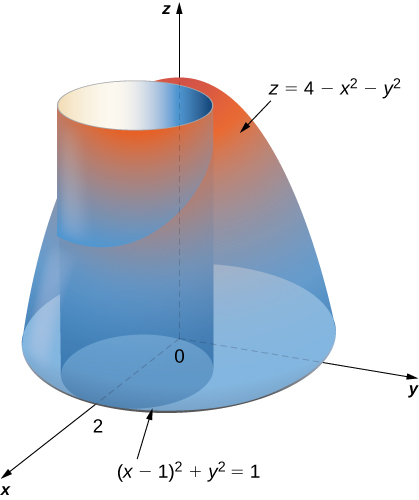
 We continue with solving problems of volume of solids in polar coordinates using double integrals. Here is another example.

Example 2


Solution

Let's first express the equation of the region which is a disk in polar coordinates. We need to find θ and r.

The equation of the disk can be expressed as::

This is a set of circles with radiuses less than or equal to1. These circles are centered in (1,0). The center can be found by rewriting the left part of the above inequality as (x-1)² + (y-0)².  The angle θ varies from 0 to 2ℼ..

Expanding the square term in the equation (x-1)² + y² = 1, we have: 


By simplification, we get : 


By substituting x = cosθ and y = sinθ, we have:


Solving this equation, we find: 


The disk on the xy plane can be expressed on the following region as:


Let's express z in polar coordinates by substituting x and y in the equation of z. We obtain z = 4-r².

Let's calculate the volume. We have:


Let's calculate the inner integral:


=  


= 8cos²θ−4cos⁴θ

Let's integrate with respect to the outer integral:


Calculating this expression we have:

V = 5/2.2π +5/2sin4π-1/8sin8π- 0 = 5𝛑/2
