Showing posts with label polar curve. Show all posts

Saturday, February 24, 2024

Arc length in polar curves

Goal : find a formula for the arc length of a curve in polar coordinates

Arc length of a curve in polar coordinates

To find the formula for the arc length of a curve in polar coordinates, let's start from the formula of the arc length of a parametrized curve (x(t), y(t)) for a≤ t ≤b  in rectangular coordinates.


In polar coordinates the curve is defined by r = f(θ) and we also have:
x = rcosθ = f(θ)cosθ and y = rsinθ =f(θ)sinθ . Let's calculate dx/dθ and dy/dθ:


Let's replace dt by dθ and a and b by ɑ and β, which define the limits of integration of the curve in polar coordinates, in the formula for the arc length above:


This leads to the following theorem:

Theorem


Friday, February 23, 2024

Area between two polar curves

 Goal: find the area between 2 polar curves

Area between 2 polar curves

The procedure to find the area  between 2 polar curves is similar to that of the area of 2 curves in the system of coordinates in the cartesian plane, We find the points of intersection between the 2 curves and identify the functions that define the outer curve and the inner curve respectively.

Example

Find the area outside of the cardioid r = 2 + 2 sinθ and inside the circle r = 6 sinθ

Solution

 First, draw a graph containing both curves


To find the limits of integration, let's find the points of intersection by setting the 2 functions equal to each other and solving for θ


The solutions of this equation are θ = ℼ/6 and θ = 5ℼ/6, which are the limits of integration. The graph of the circle, in red.. is the outer curve. The graph of the cardioid, in blue, is the inner curve. To find the area between the 2 curves, let's subtract the area of the cardioid from that of the circle.


Practice

Find the area inside the circle r = 4 cosθ and outside the circle r = 2.

Tuesday, February 20, 2024

Area of a region bounded by a polar curve (continued)

 In the previous post, we set  the formula to find the area of a region bounded by a polar curve. Let's do an application.

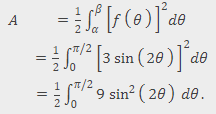
Example. Find the area of one petal of the rose defined by the equation r = 3sin (2θ)

Solution

Here is the graph of the of the petal of the rose


The first petal of the rose is traced out from the polar coordinates (0, 0) and (0, 𝝅/2). To find the area inside the petal, let's use the formula of the area of the region bounded by a polar curve. In this formula we substitute 𝛼 by 0 and 𝛽 by 𝝅/2. 


To evaluate this integral, let's use the formula sin²𝛂 = 1 - cos(2𝛂) with 𝛂 = 2𝜃

Practice

Find the area inside the cardioid defined by the equation r = 1-cos𝜃

Saturday, February 17, 2024

Areas of regions bounded by polar curves

 To find the area of a region bounded by a curve in rectangular coordinates, we use the Riemann sum to approximate the area under the curve by using rectangles. In polar coordinates, we are going to use the Riemann sum also to find the area bounded by a curve but instead of using rectangles we will use sectors of a circle. Let's consider the curve defined by the function r = f(θ) where α ≤ θ ⩽ 𝛃. Our goal is to find the area bounded by the curve and the 2 radial lines θ = α and θ =𝛃. 


Let's start by dividing the area into sectors of equal width. We name the width Δθ and it's calculated by using this formula: Δθ = 𝛃 - α/n. Let's find the area of the sectors. They have equal area since their measurement is equal. The area of each sector is used to approximate the area between line segments. We sum the area of the sectors to approximate the total area. Let's find the formula for the area of a sector.

The area of a circle is given by A = 𝝅r². The length of a circle is 360 degrees or 2π. The surface for one radian is A = 𝝅r²/2π = r²/2. The area for a sector of Δθ radians is A =  Δθ r²/2. This represents the area of any sector. Let's call it Aᵢ and substitute r by f(θ). Aᵢ = 1/2 [f(θ)]².

Let's add the areas of all the sectors to approximate the area bounded by the polar curve and the radial lines :


Let's divide the sector in as many subintervals as possible. At some point we approach infinity. The area of the sector is then given by:

Theorem                                                                                                                                                   
                                                                                                                                                 
Suppose f is continuous and non negative on the interval  α ≤ θ ⩽ 𝛃 with 0 ≤ α - 𝛃 ≤ 2𝝅. The area of the region bounded by the graph r = f(θ) between the radial lines θ = α and θ = 𝛃   is: