Showing posts with label improper integral. Show all posts

Friday, May 16, 2025

Improper integrals on an unbounded region

 We previously evaluated a double integral on a bounded region. What if the region is unbounded? The following theorem comes handy for our rescue.

Theorem


Example


Solution


Practice


Tuesday, May 13, 2025

Improper Double Integrals

 Definition of an improper integral


It's preferable to deal with improper integrals of functions over rectangles or simple regions where these functions have finitely many discontinuities. However, not such improper integrals can be evaluated. A form of Fubini's theorem allows to evaluate some types of improper double integrals.

Fubini's theorem for improper integrals


Two conditions are necessary for the theorem to work. The function has to be nonnegative on D and has many finitely discontinuities inside D.

Example


Solution

Let's start by plotting the region. 


The function f is continuous on all points of the region D except in (0,0). If you keep the expression of the region, it would be difficult to calculate the double integral. However, if we express the region in 
the following way, the double integral becomes easy to calculate.


Practice

Consider the function f(x,y) = sin(y) /y over the region:


Friday, September 27, 2019

Methods of resolution of the improper integrals

Objective: Solve the different types of improper integrals

Definition. An improper integral is an integral  where one or  the two limits of integration are infinite. An integral is also improper when the function has an infinite discontinuity. Let's look at the two scenarios:

I. One or two of the limits of integration are infinite.

a. One of the limit of integration is finite,

If f is continuous over the interval [a, +∞[, then
If the limit is finite the integral converges. If the limit is infinite the integral diverges.                                                                                                                                                          
Geometric Interpretation


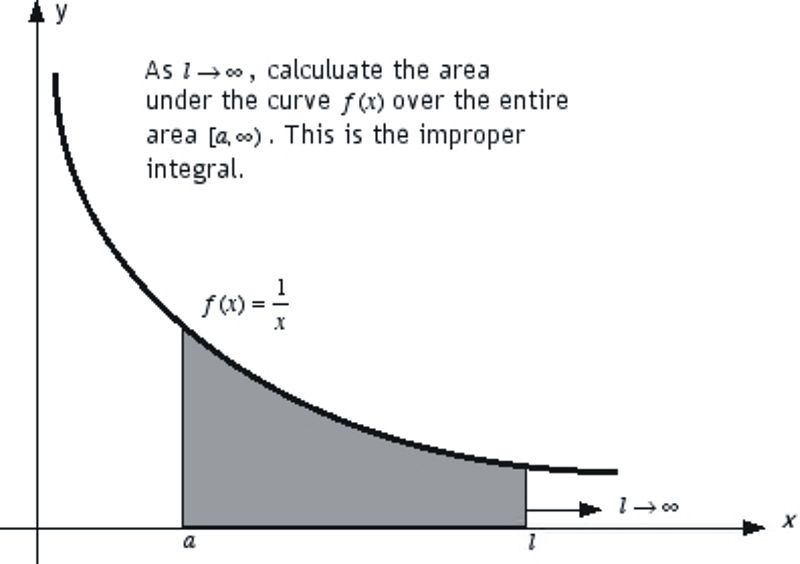
Let's consider a function f(x) = 1/x. The integral  represents the area under the curve of the function that starts from the vertical passing by a and extending to infinity.
The integral  represents the area between the verticals passing by a and l. As l approaches infinity, the area under the curve spreads to infinity. It's fair to say that this situation represents  .
 We can define  as the limit of   when l approaches infinity.
We can then set a rule to calculate the improper integral where the lower limit is finite and the upper limit is infinite. In this case we have to replace the infinite limit by l and find the limit of   when l approaches infinity.

Example 1. Calculate 

Solution

Let's replace infinity by l and calculate the limit of the finite integral when l approaches infinity.

We have:
    b. The two limits of integration are  infinite                                                                                

  In this case we choose any value a in the interval ]-∞, +∞[ and calculate the integral over the sub-intervals
 ]-∞, a[∪ ]a ,  +∞[                                                                                                                                  

Example 2. Evaluate                                                                                                     
                                                                                                                            
Solution

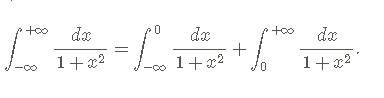
Let's split the integral over the intervasl ]-,0] and [0,+[:


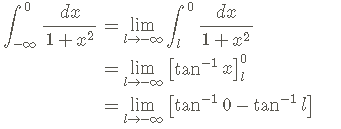
Let's evaluate the first integral on the right side:                                                                           

                                                                                                                                                         
Let's calculate the limit by substituting l by -∞:                                                                                          


Let's evaluate the second integral:                                                                                                      

                                                                                                                                                      
     Let's substitute the two integrals we obtain:


II The function to integrate is discontinued.

Let's say that we have to calculate an integral over an interval ]a, b[ where the function f is continued. If the function isn't continued at a point c of the interval, we evaluate the integral over the intervals ]a,c[∪]c,d[.

Example. Evaluate 

Solution

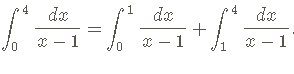
The function is discontinued at x = 1. Therefore we integrate it over the 2 intervals ]0,1[∪ ]1.4[.


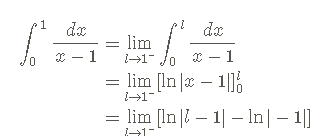
Let's calculate the first integral:

= ln │1⁻-1│-ln1
= ln o⁺
= -∞

  Since the first integral diverges there's no reason to calculate the second integral. The given integral diverges.

Exercises                                                                                                                                                           
Evaluate. Tell if the integral converges or diverges:

If you want to learn more about Calculus check this site Center for Integral Development
.