Saturday, January 25, 2020

Volume of a solid of revolution: method of cylindrical shells

In this post we are going to compute the volume of a solid rotating around the y-axis by utilizing the method of cylindrical shells.

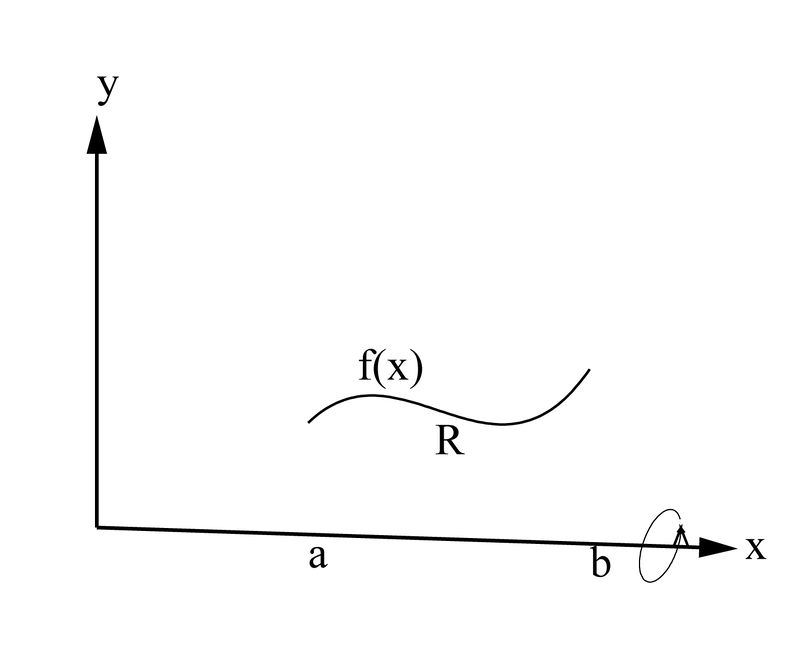
Let's consider a function f. positive over an interval [a,b]. Let R be the region bounded by the curve of the function, two verticals x = a and x = b and the x-axis..

A solid of revolution is obtained by revolving the region around the y-axis. Our goal is to determine the volume of this solid. We are going to use the method of cylindrical shells for that purpose.

Method.

Let's divide the region R in small rectangles of width dx and consider one rectangle.


Let's revolve the rectangle around the y-axis. We obtain a cylindrical shell


Let's calculate the volume of this cylindrical shell. The volume of this cylindrical shell is obtained by multiplying the volume of the outer cylinder by the thickness of the cylindrical shell. We can write:

Volume cylindrical shell = Volume outer shell * thickness.

The volume of a cylinder is equal to the surface of the base by the height. Therefore the volume of the outer shell can be written as:

Volume of outer shell = Area of base * height. The base is a circle. Its area is 2𝜋r. Then
Volume outer shell  = 2𝜋rh .

Let's substitute in Volume cylindrical shell

Volume cylindrical shell = 2𝜋rhdx (dx is the thickness)

The radius r is variable. We call it x. The height is a function of the radius. We represent it by f(x)

V cylindrical shell =  2𝜋xf(x)dx
Adding the volume of all these small cylindrical shells is going to give the volume of the entire solid of revolution. This is equivalent to integrate the volume over the interval  [a,b]. Therefore the volume of the solid of revolution is given by:


Example


Use the cylindrical shells to find the volume generated when the region bounded by the curves is revolved about  the y-axis.

y = 1/x  y = 0 x = 1 x = 3

Solution 

The volume of a cylindrical shell generated by a region around the y-axis is given by 


Practice

Find the volume generated by the lines y = 2x-1 y = -2x + 3 and 
x  = 2 about the y-axis.

Interested in Calculus and other math subjects tutoring visit 
New Direction Education Services for contact information 
Interested in online Calculus courses visit Center for Integral Development

Saturday, January 11, 2020

Volume of a solid of revolution: method of washer

According to the Merriam-Webster dictionary a washer is a flat ring or a perforated plate used in joints or assemblies to ensure tightness, prevent linkage or release friction.


The automobile mechanic technician use this type of ring to relate two pieces in fixing a car..

Washer method to compute the volume of a solid of revolution 

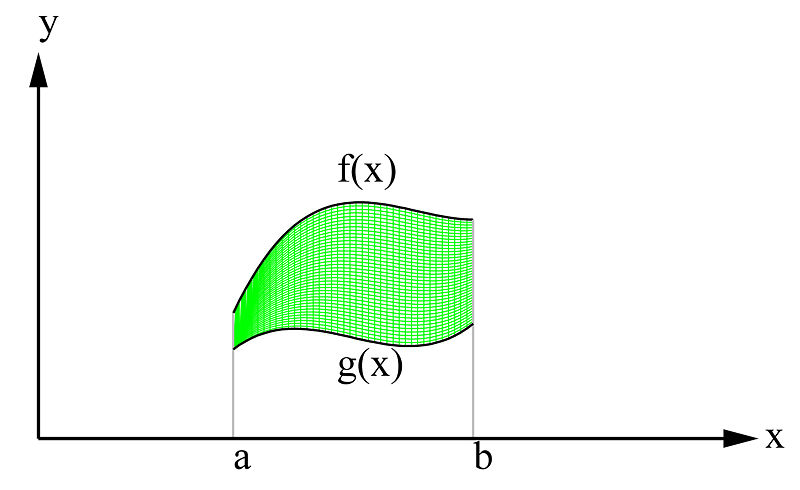
Let's consider two continuous and positive functions f and g over an interval [a,b]. Let R be the region bounded by the curves of these functions.


Let's have the shaded region revolve around the x-axis.


This is the solid we obtain. It has the shape of a hollow pot. In order to find its volume we have to integrate the cross-section, which is a washer or a flat ring as defined previously. The cross-section is shaded in the figure above.

The area of the cross-section is the difference between the area the of the circle of radius f(x) and the circle of radius g(x).

The volume of the solid of revolution is found by integrating the area:


Example

Find the volume generated when the region between the graphs f(x) = x² + 1 and g(x) = x over the interval [0,3] is revolved around the x-axis.


Solution


When the green region revolves around the x-axis it creates a solid of revolution like this:


The cross-section is a ring or washer. The volume of the solid it generates is given by:


Exercise

Find the volume generated when the region between the graphs f(x) = 2x² + 3 and g(x) = 2x over the interval [0,2]

Interested in Calculus tutoring visit New Direction Education Services for contact information
Interested in learning Calculus online visit Center for Integral Development

Friday, December 6, 2019

Volume of a solid of revolution: method of disks

In the previous post we define the formula to find the volume of a solid which consists in integrating the area of a cross-section. In the following post I am going to find another version of this formula using the method of disks.

 Method of disks


Let f be a function continuous and positive in an interval [a,b]. Let’s consider a region R between f and the x-axis. Let’s R revolve about the x-axis. This action generates a solid of revolution with cross-circular sections with radii f(x) for any value of x.

Volume formula by the method of disks

In the previous lesson we learn that the volume of a solid is found by integrating the area of the cross-circular section within a definite interval.


Example

Calculate the volume of the solid that is obtained when the region under the curve x  is revolved about the x−axis over the interval [1,7].


Here is the graph of the function f:

We revolve the region between f(x) and the x-axis. We obtain the following figure:

Since the cross-section is circular, the volume of the solid is given by:
Practice
.
Demonstrate that the volume of a sphere with radius r is V = 4𝛑r³/3

Interested in Calculus tutoring visit New Direction Education Services
Interested in learning Calculus online visit Center for Integral Development


Saturday, November 23, 2019

Application of integral: the volume formula

In arithmetic we learn the formula to calculate the volume of a  a solid such as a cube. The problem is we have to memorize the formulas for every figure. The definite integral allows us to find a general formula  for the volume of any solid.
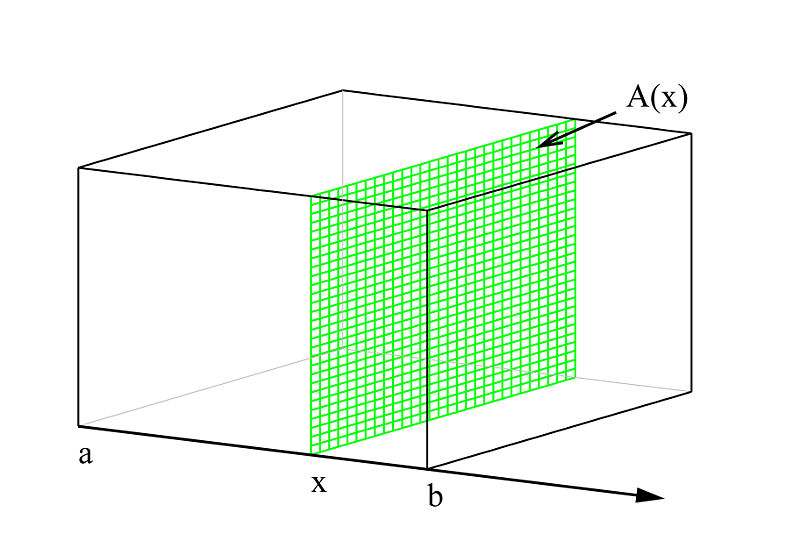
Let's consider a cubic solid limited by two parallel planes perpendicular to the x-axis. At any point x, any plan perpendicular to the x-axis is called a cross section.


In order to find the volume of this solid, we are going to divide it in different slices of widths 𝝙x₁, 𝝙x₂, 𝝙x₃ 𝝙xn. This leads to divide the interval [a,b] into different sub-intervals of lengths 𝝙x₁, 𝝙x₂, 𝝙x₃ 𝝙xn. Let's A₁, A₂, A₃... An be the different cross-sections or base of the cubic slices. The volume of the cube is equal to the sum of the volume of the different slices.

V = A𝝙x₁ + A𝝙x₂ + A𝝙x₃ + An.𝝙xn.

There is a way to write this sum simpler:


Let's divide each slice into more slices. We now have thinner slices. Let's continue to divide each slice into more slices. The slices become thinner and thinner. At each time we get a better approximation. We can notice also that each time we divide each slice the width becomes smaller and smaller. It means that 𝝙x approaches zero. When this is the case v approaches a certain value. This value represents the limit of the sum and is the value of V. We can write;


This value represents the definite integral of the function A(x) when Δx approaches zero. We can finally write in the integral form:


Application

Let's demonstrate that the volume of a pyramid is equal to one third the area of its base by its height.
If a is the length of the sides of the base and h the height V = 1/3 a²h


Since the cross section is perpendicular to the y-axis we have to integrate in respect to y. Then the volume of the pyramid can be calculated by
The cross-section A(y) varies from o to h therefore the volume V becomes

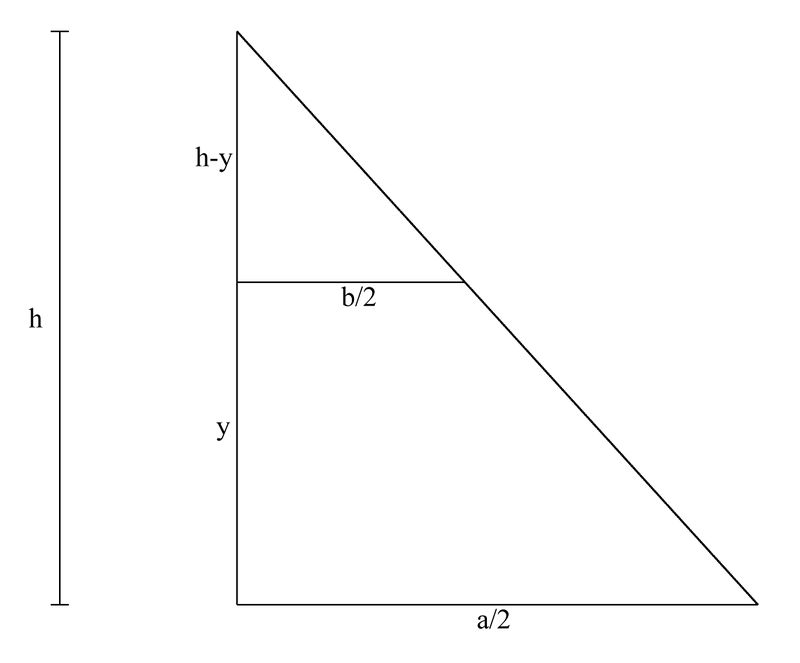
A(y) is a square of sides b. Therefore its area is b². We have A(y) = b².
Let's calculate b. To do that, let's isolate from the figure above the triangle with height h


Interested in Calculus tutoring visit New Direction Education Services

Interested in learning Calculus online visit Center for Integral Development

Friday, November 15, 2019

Area between two curves

Objective: Find the area between two curves

Method

Let's consider 2 functions f and g. We want to find the area limited by the curves of these functions and the verticals x = a and x = b.

.
The area limited by the the curves of f and g  and the two verticals passing respectively by x = a and x = b can be found by subtracting the area under the curve of g from the area under the curve of g.

Let A be the area between the 2 curves we can write:
A = Area under f-Area under g
The area under f and limited by the verticals passing by a and b and the x-axis is given by
The area under g limited by the verticals passing by a and b and the x-axis is given by
Let's substitute area under f area under g in A
According to this result, we can make the following statement:

Let f and g be two continuous functions on the interval [a,b] and f(x)≥ g(x) for all values of x in this interval, then the area between the the curves of and g is given by
Solution


Practice 

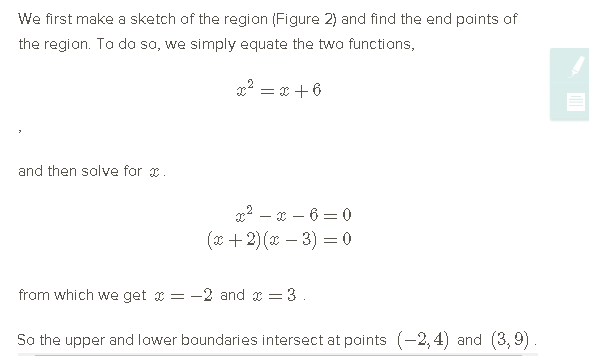
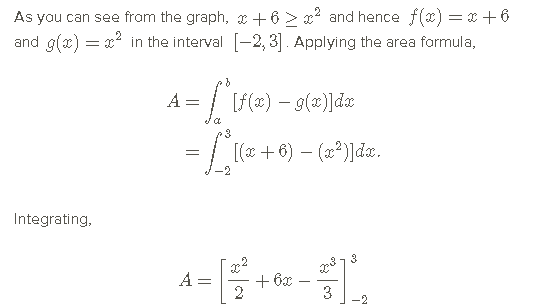
Sketch the region enclosed by the curves of y = x²and y = x + 3. Find the area. 

Interested in math tutoring including Calculus visit New Direction Education Services  
Interested in learning Calculus online visit Center for Integral Development                        

Friday, November 8, 2019

Applications of integral: area between a curve and the x- axis

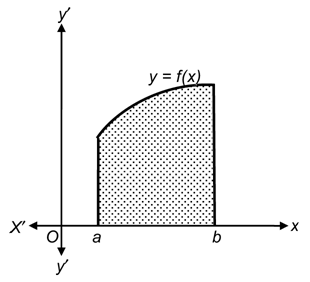
Objective: Find the area between the curve of a function f and the x-axis over an interval [a b].

Definition

The area between the curve of a function and the x-axis bounded by the verticals x = a and x = b is given by


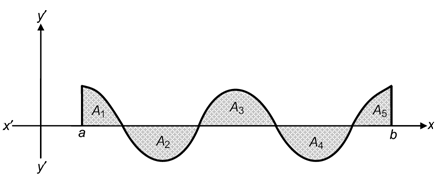
The area is positive if it is located above the x-axis and negative if it is below.


The areas A(2), A(4) are negative. The areas A(1), A(3) and A(5) are positive. The total area is the sum of all the areas: positive and negative.

Example 


Solution

Practice


         Interested in math tutoring including Calculus visit New Direction Education Services. Interested in learning Calculus online visit Center for Integral Development                                                                                                                                               

Monday, October 14, 2019

Fundamental theorem of Calculus

Fundamental theorem of Calculus

This theorem is divided in two parts:

1. First fundamental theorem of Calculus

The derivative of the integral of a function f with respect to the variable t over the interval [a, x] is
equal to the function f with respect to x. This is expressed by:


This theorem shows the relationship between the integral and the derivative. It tells us that the integral of a function f can be calculated by taking its integral over a variable bound of integration.meaning that the upper limit of integration is variable. In fact the above relationship shows that when we take the derivative of the integral we find the initial function f.

2. Second fundamental theorem of Calculus

The definite integral of a function f over an interval [a,b] is equal to the antiderivative at b minus
the antiderivative at a. If a function f is continuous over an interval [a,b] and F is an antiderivative
of f over this interval, then:


This theorem shows the relationship between the definite integral and the indefinite integral.

Practice

1. Evaluate:

Solution


2. Use the fundamental theorem of Calculus to find the derivative of


N.B. In this exercise it's dt instead of dx.

Solution


Exercise

Find the derivative of:


Interested in learning more about Calculus visit Center for Integral Development