Friday, May 9, 2025

Finding the average value of a function with 2 variables

 We have seen previously that double integrals can be used to calculate volumes and areas. We can also use double integrals to find the average value of a function with 2 variables. 

Definition

If a function f(x,y) is integrable over a plane bounded region D with positive area A(D), then the average value of f is given by:


Note that the area is:


Example

Find the average value of the function f(x,y) = 7xy² on the region bounded by the line y = x and the curve x = ⎷y.

Solution


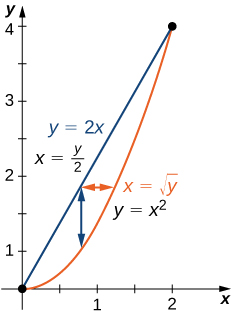
The figure above represents the region bounded by the line y = x and the curve x =⎷ y

First find the area A(D) where the region D is given by the figure above. We have:


Then the average value of this function over the given region is:


  Practice                                                                                                                                                         


Friday, May 2, 2025

Calculating areas using double integrals

 Objectives:

1) Finding the area of a rectangular region

2) Finding the area of a nonrectangular region

We can use double integrals to find the area of a rectangular region and a nonrectangular region

Area of a rectangular region

The area of a single rectangular region can be found by a simple geometric formula. It can also be found using double integrals.

By definition, the area of a plane bounded region D is given by:


Area of a nonrectangular region

We have seen that an area can be calculated using a single integral. It can also be calculated using double integrals.

Example

Find the area of the region bounded below by the curve y = x² and above by the line y = 2x in the first quadrant.

Solution


Practice


Visit this Calculus site: Learn Calculus Easily

Friday, April 25, 2025

Using double integrals to calculate the volume of a solid over general regions

 In a previous post we define the notion of general regions that allows us to calculate double integrals over these types of regions. This enables also to calculate the volume of a solid over these regions. Let's dive right into the solution of a problem.

Example


Solution

The solid is limited by the plane x = 0 or yz. the plane  y = 0 or xz, the plane z = 0 or xy and the plane 2x +3y+z = 6. First  we start by drawing the axes of coordinates then we draw part of the plane 2x+3y+z = 0. In order to do the latter, let's determine the coordinates intercepts.


Let's connect the points to form a triangle:


The triangle represents part of the plane 2x+3y+z = 6.. The plane intercepts the planes x = 0, y = 0, z = 0. This gives us the other faces of the tetrahedron, The base is limited by the x axis, the y axis and the line 2x + 3y = 6 as seen on the right. 


Looking at the figure we see a solid with 4 triangular faces, It's called a tetrahedron or triangular pyramid. It consists of the three coordinates planes, the plane z = -2x-3y+6 with the bases limited by the lines y =o, x = 0 and the line 2x +3y = 6.


Practice


Friday, April 18, 2025

Changing the order of integration in the calculation of a double integral

 As we have seen before, sometimes one order of integration can make the calculation of a double integral easier than another order. Another time the order of integration doesn't matter. It iis important to recognize when a change in the order of integration can facilitate the work.

Example


Solution


Friday, April 11, 2025

Decomposing regions into smaller regions in the calculation of double integrals

 Decomposition of regions into smaller regions in the calculation of double integrals

Goal: Decompose a region into smaller regions in the calculation of double integrals.

The properties of double integrals over rectangular regions are valid for the the calculation of double integrals over non rectangular bounded region on a plane. The property 3 of double integrals over rectangular region states:


The following theorem establishes the same property for double integrals over non rectangular regions on a plane.


Theorem 

Suppose the region D can be expressed as D = D₁∪D₂ where D₁ and D₂ do not overlap except at their boundaries.


Example


Solution

Here D₁ is type 1 and D₂ and D₃ are type 2. Hence:


Friday, April 4, 2025

Evaluating a double integral over a type II region

 We continue in the evaluation of double integrals over non-rectangular regions. In the previous post, we solve a double integral over a type I region. In this post, we evaluate the double integral of a function over a type II region.

Example


Solution


Practice


Let's connect in this new Calculus group: Learning Calculus Easily 

Friday, March 28, 2025

Double integrals over non-rectangular regions

 Goal: Evaluate a double integral over a nonrectangular region

In the previous post, we stated that, in order to evaluate a double integral over a general, non-rectangular region we need to express this region as a type I or type II, The following theorems allow to reach this goal.

Theorem I

Double integrals over nonrectangular regions

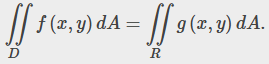
Suppose g(x,y) is the extension to the rectangle R of the integrable function f(x,y) defined on the region D where D is inside R. Then g(x,y) is integrable and we define the double integral f(x,y) over D by:


Theorem II


Example


Solution