Friday, January 5, 2024

Limit of a vector-valued function

 Goal: Determine the limit of a vector-valued function

Definition


This is a rigorous definition. In practice we apply the following theorem:

Theorem

Limit of a vector-valued function

Let f, g, h be functions of t and r(t) = f(t)i + g(t)j, the limit of r as t approaches a is defined by:


Similarly, the limit of the vector-valued function r(t) = f(t)i + g(t)j + h(t)k as t approaches a is defined by:


Examples

For each of the vector-valued functions calculate lim r(t) when t approaches 3:

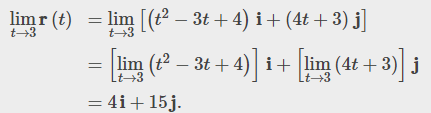
a. r(t) = (t²- 3t + 4)i + (4t + 3)j

b. r(t) = (2t-4/t+1)i + (t/t²+1)j + (4t - 3)k

Solution

a. Using the definition of limit above and substituting t, we have:


b. Doing the same:


Practice

Calculate limr(t) when t approaches 2 for:


Graph of a vector-valued function

Goal:  Graph of a vector-valued function

Considerations

A vector is defined by two quantities: magnitude and direction. If we consider an initial point and move in a certain direction according to a certain distance, we arrive at a second point. The second point is the terminal point. To determine the coordinates of a vector, we subtract the coordinates of the original point from those of the terminal point.

A vector is said to be in standard position if if its original point is located in the origin. In order to maintain the uniqueness of the graph of a vector-valued function, we start by graphing the vectors in the domain of the function.. The graph of a vector-valued function of the form r(t) = f(t)i + g(t)j is the sets of all (t, r(t)) and the path it traces is called a plane curve. The graph of a vector-valued function of the form r(t) = f(t)i + g(t)j + h(t)k and the path it traces is called a space curve. Any representation of a plane curve or space curve using a vector-valued function is called a vector parameterization of the curve.  

Examples

Create  a graph of each of the vector-valued functions:

a. The plane curve represented by r(t) = 4costi + 3sintj 0 ≤ t ≤ 2ℼ

b. The plane curve represented by r(t) = 4costi + 3sintj 0 ≤ t ≤ π

Solutions

a. We start by creating a table of values made of values of t in the domain of the vector valued-function and corresponding values of r(t). We graph each of the vectors of the second column in standard form and connect the terminal point of each vector to form a curve. It turns out that the curve is an ellipse centered at the origin 


Graph


b. Let's do the same for the same for the second example.

Table of values


Graph

The graph of this curve is an also an ellipse centered at the origin.


Practice

Create of the vector-valued function:


Saturday, December 23, 2023

How to evaluate vector-valued functions

 Goal

 Evaluate vector valued functions

Definition

A vector-valued function is a function of the form:


The functions f, g, h are real-valued functions of the parameter t. Vector-valued functions are also written in the form:


The first form defines a two-dimensional vector-valued function. The second form describes a tri-dimensional vector-valued function. 

Example

For each of the vector-valued functions, evaluate r(0), r(π/2), r(2π/3). Do any of these functions have domain restrictions?


Solution

a. Let's substitute each of the value of t in the function:


To determine a domain restriction let's consider each component function separately. The function cost is defined for all values of t. The function sint is also defined for all values of t. Therefore the function r(t) is defined for all values of t

b. Let's do the same thing for the second function:


The component functions tant and sect are not defined for odd multiples of π/2. Therefore the vector valued-function r(t) is not defined for odd multiples of  π/2. 


Practice

For the vector-valued function r(t) = (t²-3t)i + (4t + 1)j, evaluate r(0), r(1), r(-4). Does this function have any domain restrictions?


Saturday, December 16, 2023

Arc length of a parametric curve

 Let's consider the plane curve defined by the following parametric equations:

x = x(t) y = y(t)    t₁≤t ≤t₂ and let's assume that x(t) and y(t) are differentiable functions of t, then the arc length of the parametric curve is given by:


This video gives an idea of where this formula originates:


Example

Find the arc length of the semicircle defined by the equations:


Solution

Here is the graph of the semicircle:


Let's use the formula to find the arc length:


Practice

Find the arc length of the curve defined by the equations:


Saturday, December 9, 2023

Area under a parametric curve

 Goal: Finding the area under the curve of a parametric equation

Area under parametric curve

Let's consider the the area of the curve bounded by the curve y = f(x), the x-axis and the verticals x = a and x = b


We know that the area is given by:


We assume that the curve is given by the parametric equations: x = x(t) y = y(t). The formula above becomes:


The formula that allows to find the area under a parametric curve is then given by:


Example

Find the area under curve of the cycloid define by the equations:

x(t) = t-sint   y(t) = 1-cost  0  ≤ t ≤ 2π

Solution

Using the formula we have:


Practice

Find the area under the curve of the hypocycloid defined by the following equations:

x(t) = 3cost + cos3t   y(t) = 3sint - sin3t  0 ≤  t ≤ π 

Friday, December 1, 2023

Second Order Derivatives

 The second order derivative of a function y = f(x) is the derivative of the first derivative of the function.

The first derivative of the function f is dy/dx.

The derivative of the first derivative is :d/dx[dy/dx] = d²y/dx²

The relation equality being commutative, we can write: d²y/dx² = d/dx[dy/dx].

Let's apply the formula of the first derivative. According to this formula, the derivative of y = f(x) is the derivative of the function y with respect to t divided by the derivative of x with respect to t.

The function here is dy/dx. Let's calculate its derivative:

 d²y/dx² = d/dt[dy/dx]./dx/dt.

The second order derivative is the derivative of the derivative of the first derivative with respect to t divided by the derivative of x with respect to t.

Examples

Calculate the second derivative  d²y/dx² for the plane curve defined by the parametric equations:


 Solution

We have :

 d²y/dx² = d/dt[dy/dx]./dx/dt.

Let's calculate dy/dx. According to the formula of the derivative, we know that the derivative is equal to the derivative of y with respect to t divided by the derivative of x with respect to t.

dy/dx = y'(t)/x'(t) = 2/2t = 1/t

Let's calculate dx/dt also:

dx/dt = 2t

The expression of d²y/dx² becomes:

d²y/dx² = d/dt (1/t)/2t = -1/t²/2t = (-1/t²)(1/2t) = -1/2t³

Practice

Calculate the second derivative  d²y/dx² for the plane curve defined by the parametric equations:


Locate any critical points on its curve.


Friday, November 10, 2023

Derivative of parametric equations

 Objective: to find the derivative of parametric curves

Derivatives of parametric equations

Let's consider the plane curve defined by the parametric equations:

x(t) = 2t + 3  y(t) = 3t - 4       -2≤ x≤3

Our objective is to determine the derivative of the parametric equations. Let's note that the derivative of a function is a function that represents the slopes of all the tangent lines at different points of the curve. If  we know the slope of a tangent line at a point we can know the slopes of all the tangent lines at different points of the curve of the function. The slope of a tangent line at a point is the derivative of the function at a point. The function that allows to find the derivative at a point allows to determine the derivatives of all points of the function. Determining the slope of a tangent line to the parametric curve will allow us to determine the derivative of the parametric equations.

The curve of the parametric equations is a line starting at (-1, -10) and ending at (9, 5). 


Let's find the explicit form of the parametric equations. To do this we start by eliminating t in x(t):


Let's substitute t in y(t):


The slope of the tangent line is 3/2. The derivative is dy/dx = 3/2

But dy/dx = dy/dt/dx/dt = y'(t)/x'(t)

x'(t) = 2 y'(t) = 3

dy/dx = 3/2

In both cases dy/dt = 3/2. The expression dy/dx = y'(t)/x'(t) is the derivative of the function.

Theorem. Derivative of Parametric equations

Consider the plane curve defined by x = x(t) and y = y(t). Suppose that x'(t) and y'(t) exist, and then assume x'(t) ≠ 0. Then the derivative dy/dx is given by:

Examples

Calculate the derivative dy/dx for each of the parametrically defined curves and locate any critical points on their respective graph. 


Solutions

a) Let's calculate dy/dx: dy/dx = y'(t)/x'(t)

From the parametric equations in example a) we have: y'(t) = 2 and x'(t) = 2. Therefore:

dy/dx = 2/2t = 1/t

A critical point is a point where the derivative is equal to zero or undefined. The derivative is undefined for t = 0. Let's determine the critical point. Substituting t in the parametric equations, we find x = -3 and y = -1. (-3, -1) represents the critical point. The graph of the curve is a parabola opening on the right and the point (-3, -1) is a vertex of this parabola.


b)  I provided a guided solution for examples b) and c) .We have for example b)


Since the denominator is different of zero, the only critical points are those for which the numerator is equal to zero. That happens when t = -1 or t = 1 for which the critical points are: (-1, 6) and (3, 2) respectively. Here is the graph of the parametric curve.


The point (-1, 6) is a relative maximum and the point (3, 2) is a relative minimum.

c) We have : dy/dx = -cost/sint

The derivative is 0 for cost = 0. That happens when t = π/2 or t = 3𝛑/2 to which correspond respectively the critical points (0,5) and (0, -5).

When sint = 0, the corresponding values of t are : t = 0, t = π, t = 2π. The critical points are respectively:

(5. 0), (-5, 0) and (5. 0).

Here is the graph of the parametric equations defined in part example c)


Practice

Calculate the derivative dy/dx for the plane curve defined by the following equations and locate any critical points on its graph: