Friday, November 10, 2023

Derivative of parametric equations

 Objective: to find the derivative of parametric curves

Derivatives of parametric equations

Let's consider the plane curve defined by the parametric equations:

x(t) = 2t + 3  y(t) = 3t - 4       -2≤ x≤3

Our objective is to determine the derivative of the parametric equations. Let's note that the derivative of a function is a function that represents the slopes of all the tangent lines at different points of the curve. If  we know the slope of a tangent line at a point we can know the slopes of all the tangent lines at different points of the curve of the function. The slope of a tangent line at a point is the derivative of the function at a point. The function that allows to find the derivative at a point allows to determine the derivatives of all points of the function. Determining the slope of a tangent line to the parametric curve will allow us to determine the derivative of the parametric equations.

The curve of the parametric equations is a line starting at (-1, -10) and ending at (9, 5). 


Let's find the explicit form of the parametric equations. To do this we start by eliminating t in x(t):


Let's substitute t in y(t):


The slope of the tangent line is 3/2. The derivative is dy/dx = 3/2

But dy/dx = dy/dt/dx/dt = y'(t)/x'(t)

x'(t) = 2 y'(t) = 3

dy/dx = 3/2

In both cases dy/dt = 3/2. The expression dy/dx = y'(t)/x'(t) is the derivative of the function.

Theorem. Derivative of Parametric equations

Consider the plane curve defined by x = x(t) and y = y(t). Suppose that x'(t) and y'(t) exist, and then assume x'(t) ≠ 0. Then the derivative dy/dx is given by:

Examples

Calculate the derivative dy/dx for each of the parametrically defined curves and locate any critical points on their respective graph. 


Solutions

a) Let's calculate dy/dx: dy/dx = y'(t)/x'(t)

From the parametric equations in example a) we have: y'(t) = 2 and x'(t) = 2. Therefore:

dy/dx = 2/2t = 1/t

A critical point is a point where the derivative is equal to zero or undefined. The derivative is undefined for t = 0. Let's determine the critical point. Substituting t in the parametric equations, we find x = -3 and y = -1. (-3, -1) represents the critical point. The graph of the curve is a parabola opening on the right and the point (-3, -1) is a vertex of this parabola.


b)  I provided a guided solution for examples b) and c) .We have for example b)


Since the denominator is different of zero, the only critical points are those for which the numerator is equal to zero. That happens when t = -1 or t = 1 for which the critical points are: (-1, 6) and (3, 2) respectively. Here is the graph of the parametric curve.


The point (-1, 6) is a relative maximum and the point (3, 2) is a relative minimum.

c) We have : dy/dx = -cost/sint

The derivative is 0 for cost = 0. That happens when t = π/2 or t = 3𝛑/2 to which correspond respectively the critical points (0,5) and (0, -5).

When sint = 0, the corresponding values of t are : t = 0, t = π, t = 2π. The critical points are respectively:

(5. 0), (-5, 0) and (5. 0).

Here is the graph of the parametric equations defined in part example c)


Practice

Calculate the derivative dy/dx for the plane curve defined by the following equations and locate any critical points on its graph:




Saturday, October 28, 2023

Parameterization of a curve

 Objective:

Transform the function of a curve into parametric equations.

Parameterization of a curve

In the previous lesson we learn how to eliminate the parameter in the parametric equations of a curve. In this post we do the reverse meaning transforming a function of a curve into parametric equations.

Example

Find two different pairs of parametric equations to represent the graph of y = 2x² - 3

Solution

One of the easiest way to do this is to write x(t) = t and substitute x in the function. The result is y = 2 t²-3.

The first set of pair of parametric equations is x(t) = t y = 2t²-3

Since there is no restriction on the domain of the function, we can have a variety of expressions of x in function of t and then substitute x in the function.

For the second pair of equations let's choose x(t) = 3t-2

Let's substitute x in the function:


Therefore a second parameterization of the function is represented by:


Practice

Find two different sets of parametric equations to represent the graph of y = x² + 2x


Friday, October 20, 2023

Converting the parametric equations of a curve into an explicit form

 Objective: Convert the parametric equations of a curve into the form y = f(x)

Conversion of the parametric equations of a curve into an explicit form

Usually we are more accustomed in graphing the curve of a function represented explicitly meaning representing a relation between y and x. It is possible to convert the parametric equations of a curve into its explicit form.  The process is very simple. It consist in finding the expression of t in one of the parametric equations and then substituting it in the other. 

Examples:


a) let's solve example a)

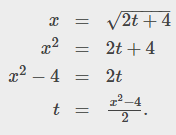
Let's find t in the first equation. We can also find it in the second equation.


Let's substitute t in the second equation:


This is the equation of a parabola opening upward. The limits of the parameter lead to a domain restriction of the function.

The interval for t is mentioned in the problem: -6≤t≤-2

Let's substitute t = -6 in the expression of x, we find x = 0. Let's substitute t = -2 in the expression of x, we find x = 4. The domain of the function is D = [0,4].


b) I am not going to solve completely the example 2. I'll give some steps. 

Instead of solving for t find sint and cost in both equations. Substitute sint and cost in the identity sin²t + cos²t = 1. The equation found is the equation of an ellipse centered in the origin.

Practice

Eliminate the parameter for the plane curve defined by the following parametric equations and describe the resulting graph:

x(t) = 2 + 3/t  y(t) = t-1  2≤t≤6


Tuesday, October 10, 2023

What are parametric equations and how to graph their curve

 Objectives:

1. Define parametric equations

2. Plot their curve

Considerations

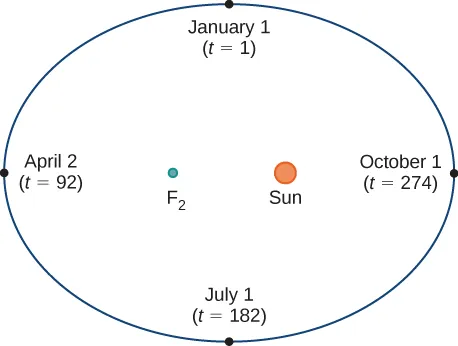
Let's consider the orbit of the earth around the sun. 


The earth revolves around the sun in 365.25 days. In this case, we consider 365 days. Each number in the figure represents the position of the earth in respect to the sun. The letter t represents the number of the Day. For example t = 1 means Day 1 that corresponds to January 1st, t = 274 means Day 274 and corresponds to October 1, and so on. According to Kepler's laws of planetary movement, the orbit of the earth around the sun is an ellipse with the earth at one of the foci.

Let's superimpose the ellipse on a system of coordinates (x,y):


Now that the orbit is placed in a system of coordinates, each point is defined as a pair (x,y) where x and y are functions of t. Each point of the ellipse is defined by its coordinates (x(t), y(t)). This pair defines the parametric equations of the ellipse where t is the parameter.


Definition

If x and y are continuous functions of t on an interval I, then the equations x = x(t) and y = y(t) are called parametric equations and t is called the parameter. The set of points (x,y) obtained as t varies over the interval I is called the graph of the parametric equations. The graph of parametric equations is called a parametric curve or plane curve, and is denoted by C

Notice in this definition that x and y are used in two ways. The first is as functions of the independent variable t. As t varies over the interval I, the functions x(t) and y(t) generate a set of pairs (x,y). This set of ordered pairs generates the graph of the parametric equations. In this second usage, to designate the ordered pairs, x and y are variables. It is important to distinguish the variables x and y from the functions x(t) and y(t). 


Examples


Solution


Plotting the points on the second and third columns allows to draw the graph of the parametric equations. The arrows on the graph indicate the orientation of the graph that is the direction of a point on the graph as t varies from -3 to 2.


Example c.

In this case, use multiples of π/6 for t and create another table of values:

t          x(t)                  y(t)              t             x(t)                     y(t)

0          4                      0                 7π/6        -2⎷3 ≃ -3.5       2

π/6       2⎷3≃ 3.5        2                4π/3           -2                   -2⎷ 3≃ -3.5

π/3        2                  2⎷3≃ 3.5    3π/2            0                     -4

π/2        0                   4                 5π/3            2                      -2⎷≃ -3.5

2π/3       -2                 2⎷ ≃ 3.5     11π/6         2⎷≃ 3.5            2

5π/6        2⎷3≃ -3.5      2              2π               4                       0

π              -4                 0                  


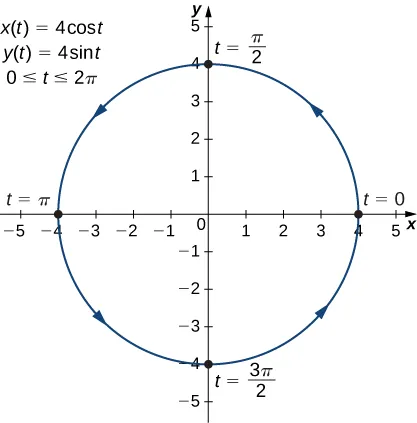
The graph of this plane curve appears in the following graph:


This is the graph of a circle with radius 4 centered at the origin, with a counterclockwise orientation. The starting point and the ending point of the curve both have coordinates (4,0).

Practice. Solve example b) 

Saturday, July 15, 2023

Evaluating non-elementary integrals

 Objective:

Use Taylor series to evaluate non-elementary integrals


Example


Solution


Practice


Solving differential equations using power series

 Objective: Solve differential equations using power series.

Let's consider the differential equation y'(x) = y. Recall that this is a first order separable equation and its solution is y = Ce^x. For most differential equations there are not any analytical tools to solve them. Power series are an extremely useful tool to solve them. The technique we use is to look for a solution of the form 


Then we determine the coefficients in order to solve the differential equation.

Example


Solution


Using the uniqueness of power series representations, we know that these series can only be equal if their coefficients are equal. Therefore:


Practice


Differentiating a power series to find a new power series

 Objective: Differentiate a power series to find a new power series

We showed in an earlier post that it's  possible to differentiate a power series term by term to create a new power series. In the following example we are going to differentiate the binomial series term by term to find a new binomial  series.

Example


Solution

There are 2 ways to solve this problem. First, we can differentiate term by term the first expression to find the binomial series of the second expression. Another easier way is to notice that the second expression is almost the derivative of the first one.

Differentiating the first expression, we have:


We deduct that:


Let's calculate d/dx⎷1+x:
The binomial series for ⎷1+x: is given by:


Practice